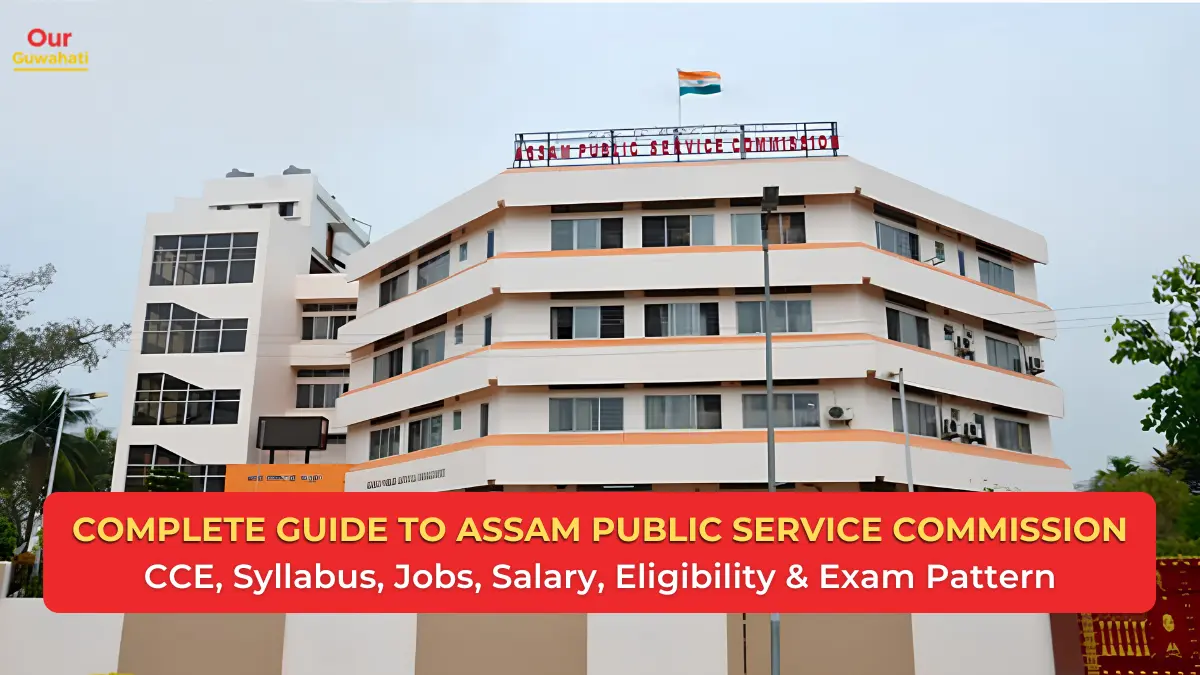

APSC, or the Assam Public Service Commission, is one of the most important recruitment bodies for aspirants who want to enter Assam’s administrative, police, revenue, taxation, transport, labour, and allied public services. For educated candidates between 18 and 40, especially those preparing for government jobs in Assam, understanding the APSC CCE, eligibility, syllabus, exam pattern, posts, salary, and selection process is the first serious step toward a structured preparation journey. The official APSC website lists recruitment advertisements, notifications, examination schemes, syllabi, answer keys, and updates for candidates.
What is APSC CCE?
The APSC CCE, or Assam Public Service Commission Combined Competitive Examination, is a competitive examination conducted to recruit candidates into different Group A and Group B services under the Government of Assam. In simple terms, this is the state-level civil services examination for Assam. Through this exam, selected candidates can enter services such as Assam Civil Service, Assam Police Service, Superintendent of Taxes, Labour Officer, District Transport Officer, Block Development Officer, Assistant Employment Officer, and other important administrative posts, depending on the vacancy notification of that year.
The APSC CCE is not just one exam but a complete selection system. It generally includes the Preliminary Examination, Main Examination, and Interview or Personality Test. The Preliminary stage screens candidates for the Main Examination, while the Main and Interview stages decide the final merit. This makes the exam both knowledge-based and personality-oriented. A candidate preparing for Assam Public Service Commission jobs must therefore understand not only facts and concepts but also governance, current affairs, Assam-specific issues, writing ability, and decision-making.
| Particular | Details |
|---|---|
| Full Form | Assam Public Service Commission Combined Competitive Examination |
| Common Name | APSC CCE |
| Conducting Body | Assam Public Service Commission |
| Type of Exam | State Civil Services Examination |
| Recruitment Level | Group A and Group B services under Assam Government |
| Major Services | ACS, APS, Superintendent of Taxes, District Transport Officer, Labour Officer, BDO, and allied services |
| Exam Stages | Preliminary Examination, Main Examination, Interview/Personality Test |
| Prelims Nature | Objective-type screening test |
| Mains Nature | Descriptive written examination |
| Interview Nature | Personality assessment/viva voce |
| Official Website | apsc.nic.in |
| Application Mode | Online, as per notification |
| Target Candidates | Graduates seeking administrative and government service roles in Assam |
| Latest CCE Reference | APSC CCE 2025 notification under Advertisement No. 01/2026 was listed for 78 posts, with applications starting from 13 April 2026 according to official advertisement listings and current recruitment reports. |
The reason APSC remains important is simple: it gives aspirants a direct route into governance. Instead of applying for a single post, candidates compete for a pool of services through a single major examination. This is why many aspirants treat the Assam Public Service Commission CCE as a career-defining opportunity rather than just another recruitment test.
APSC Official Website – apsc.nic.in
The official website of APSC is apsc.nic.in, and candidates should treat it as the primary source for all official updates. Many coaching sites and job portals publish summaries, but the final authority for advertisements, corrigenda, answer keys, exam schedules, syllabi, and result notices remains the official Assam Public Service Commission website. The site has dedicated areas for advertisements, notifications, examination schemes, syllabus details, answer keys, and other candidate-facing updates.
For an aspirant, checking the APSC site regularly is not optional. APSC notification dates, admit card updates, exam programme changes, corrigenda, and candidate lists may affect preparation and application timelines. For example, current reports around the APSC CCE 2025 recruitment cycle mention Advertisement No. 01/2026, 78 posts, application dates from 13 April 2026 to 3 May 2026, and a preliminary exam programme dated 5 July 2026. Candidates should still verify such details directly from the official APSC website before taking action.
The Role of APSC
The role of APSC is to ensure that recruitment to important Assam Government services happens through a structured, competitive, and merit-based system. The Assam Public Service Commission conducts examinations and selection processes for various posts, helping government departments identify suitable candidates for administrative and technical responsibilities. In practical terms, APSC acts as a bridge between government departments that need officers and candidates who want to serve in public administration.
The Assam Public Service Commission is especially important because government officers selected through the CCE are not limited to desk roles. They may be responsible for law and order, revenue administration, development schemes, public grievance handling, field inspections, taxation, transport regulation, disaster response, welfare delivery, and coordination between departments. This makes the APSC CCE a high-responsibility exam. Candidates are not only preparing for marks; they are preparing for public decision-making.
Another key role of APSC is standardisation. Without a commission-led recruitment process, selection for different government posts could become fragmented, inconsistent, or opaque. Through written examinations, interviews, document verification, and merit lists, APSC gives candidates a predictable recruitment structure. This is why the APSC Exam Pattern, syllabus, eligibility rules, and notification details matter so much to aspirants.
Key Functions, Roles, and Responsibilities of the Assam Public Service Commission (APSC)
The Functions of APSC are directly connected to fair recruitment and administrative efficiency. The commission conducts competitive examinations, direct recruitment processes, departmental examinations where applicable, interviews, screening tests, and selection-related procedures for various posts under the Assam Government. It also issues advertisements, publishes exam schemes, releases answer keys, declares results, and manages the procedural side of recruitment.
The Assam Public Service Commission also contributes to the larger governance ecosystem of the state. When APSC selects officers for administrative, police, revenue, transport, labour, and allied services, it indirectly influences how policies are implemented on the ground. A well-selected officer can improve public service delivery, strengthen accountability, manage local issues better, and support development programmes across Assam.
| Area | Key Function of APSC | Why It Matters |
|---|---|---|
| Recruitment | Conducts exams and interviews for government posts | Ensures merit-based selection |
| Notification | Publishes advertisements and application details | Gives candidates official recruitment information |
| Exam Structure | Provides exam schemes and syllabus | Helps aspirants prepare in a focused manner |
| Screening | Uses prelims or screening tests where required | Filters candidates for advanced stages |
| Evaluation | Conducts written exams and interviews | Tests knowledge, aptitude, writing, and personality |
| Result Publication | Releases merit lists and selection updates | Maintains transparency in recruitment |
| Departmental Support | Helps departments fill suitable posts | Supports administrative functioning |
| Candidate Guidance | Publishes instructions, eligibility, and updates | Reduces confusion among applicants |
The Key Responsibilities of APSC Officers vary depending on the post, but the broader expectation remains the same: they must serve the public, implement government policies, maintain administrative discipline, and solve real problems at the field level. An ACS officer may handle district or sub-divisional administration, while an APS officer may deal with policing and law-and-order duties. A taxation officer may focus on revenue collection, compliance, and enforcement, while a transport officer may regulate vehicle-related administration and road transport rules.
APSC preparation is not only about clearing prelims and mains. It is also about understanding what the job demands are after selection. Candidates who know the Key Responsibilities of APSC Officers are often better prepared for the interview stage because they can connect their answers with governance, public service, Assam’s socio-economic realities, and administrative ethics.
List of Jobs Under APSC
The APSC posts list changes depending on the official vacancy notification. However, the Combined Competitive Examination usually includes several prestigious administrative and allied services. The latest APSC CCE cycle mentioned in the current recruitment reports includes 78 vacancies across different services, but candidates must verify the final post-wise breakup from the official advertisement before applying.
The APSC posts list is one of the biggest reasons why the exam attracts serious aspirants. Many posts offer field authority, administrative exposure, long-term career growth, social respect, and stable government service. The apsc salary also differs by service, pay band, grade pay, allowances, and later promotions. Salary details available through recruitment summaries show that many major APSC CCE posts fall under pay scales such as ₹30,000–₹1,10,000 with different grade pay levels, but the exact salary must be checked against the official notification and current Assam Government pay rules.
| Post Under APSC CCE | Nature of Work | Indicative Pay Scale / Grade Pay |
|---|---|---|
| Assam Civil Service (ACS), Junior Grade | General administration, development work, revenue coordination, public grievance handling | Commonly reported around ₹30,000–₹1,10,000 with grade pay around ₹13,300, subject to rules |
| Assam Police Service (APS), Junior Grade | Police administration, law and order, public safety, investigation supervision | Commonly reported around ₹30,000–₹1,10,000 with grade pay around ₹12,700–₹13,300, subject to rules |
| Superintendent of Taxes | Tax administration, revenue enforcement, compliance monitoring | Commonly reported around ₹30,000–₹1,10,000 with grade pay around ₹12,700 |
| District Transport Officer | Transport regulation, vehicle administration, permit and enforcement duties | Commonly reported around ₹30,000–₹1,10,000 with grade pay around ₹12,700 |
| Labour Officer | Labour welfare, workplace compliance, dispute-related administrative support | Commonly reported around ₹22,000–₹97,000 with grade pay around ₹9,100 |
| Block Development Officer | Rural development, scheme implementation, block-level administration | Commonly reported around ₹30,000–₹1,10,000 with grade pay around ₹12,700 |
| Assistant Employment Officer | Employment exchange functions, employment support, workforce-related services | Commonly reported around ₹22,000–₹97,000 with grade pay around ₹9,400 |
| Inspector of Taxes | Tax inspection, compliance checks, field verification | Commonly reported around ₹22,000–₹97,000 with grade pay around ₹9,100 |
| Inspector of Excise | Excise regulation, inspection, enforcement support | Commonly reported around ₹22,000–₹97,000 with grade pay around ₹9,100 |
| Assistant Audit Officer / Allied Posts | Audit, accounts, compliance, departmental financial review | Commonly reported around ₹22,000–₹97,000 with grade pay around ₹9,400 |
The salary table should be read carefully. APSC salary is not just basic pay. Government employees may also receive allowances as admissible under state rules, and total monthly compensation can change with posting, pay revision, promotion, deductions, and service category. For content accuracy, aspirants should always cross-check the salary details from the latest APSC notification and Assam Government pay rules before making career decisions.
APSC Exam Details
The APSC exam details include the exam pattern, selection process, eligibility, syllabus, application process, notification status, and post-selection procedure. This section is the practical core of the article because it helps candidates understand what to study, who can apply, how the exam moves from one stage to another, and what happens after selection.
APSC Exam Pattern
The APSC Exam Pattern usually follows three major stages: Preliminary Examination, Main Examination, and Interview or Personality Test. The Preliminary Examination is objective in nature and works mainly as a screening test. The Main Examination is descriptive and evaluates written expression, analysis, knowledge depth, and conceptual clarity. The Interview checks personality, awareness, communication, judgment, and suitability for public service.
For the APSC CCE Preliminary Examination, the current exam pattern references mention two objective-type General Studies papers of 200 marks each, making the prelims total 400 marks. Each paper is usually for two hours. The Prelims marks are generally used for screening, while the final merit is based on later stages as per the official rules of that examination cycle.
| Stage | Paper / Component | Type | Marks | Purpose |
|---|---|---|---|---|
| Preliminary Exam | General Studies Paper I & CSAT | Objective | 200 | Screening |
| Main Exam | Written Papers | Descriptive | As per the latest scheme | Merit evaluation |
| Interview | Personality Test / Viva Voce | Oral assessment | As per the latest notification | Final personality assessment |
The APSC Exam Pattern should not be studied only as a table. Aspirants should understand how each stage demands a different preparation style. Prelims require speed, accuracy, elimination technique, and broad coverage. Mains requires answer writing, structure, examples, Assam-specific analysis, and balanced arguments. An interview requires clarity of thought, honesty, awareness of Assam, and understanding of public service responsibilities.
APSC CCE Syllabus and Exam Pattern Connection
The APSC CCE syllabus and exam pattern must be studied together because the syllabus tells candidates what to study, while the pattern tells them how that knowledge will be tested. For example, if a topic appears in Prelims, aspirants need factual and conceptual command. If the same theme appears in Mains, they need analytical and descriptive writing ability. This is why a serious candidate should not prepare the APSC Syllabus in isolation.
Current syllabus summaries mention that the Main Examination includes compulsory descriptive papers such as Essay, General Studies papers, Ethics, and Assam-specific content, though candidates must verify the latest paper structure from the official APSC syllabus before preparing.
APSC Selection Process
The APSC selection process usually begins with the official notification and online application. After that, eligible candidates appear for the Preliminary Examination. Candidates who qualify for the prelims are shortlisted for the Main Examination. Those who clear the main stage are called for an interview or a personality test. The final selection is then made according to merit, category rules, vacancy availability, document verification, and service preference as applicable.
| Step | Selection Stage | What Happens |
|---|---|---|
| 1 | APSC notification | An advertisement is released with posts, dates, eligibility, and the application process |
| 2 | Online application | Candidates apply through the prescribed portal |
| 3 | Preliminary Examination | Objective screening test |
| 4 | Prelims result | Qualified candidates become eligible for mains |
| 5 | Main Examination | Descriptive written papers |
| 6 | Mains result | Shortlisted candidates are called for interview |
| 7 | Interview / Viva Voce | Personality and suitability assessment |
| 8 | Final result | Merit list and service allocation as per rules |
| 9 | Appointment formalities | Document verification, training, and posting-related steps |
The selection process is long, so aspirants should plan their preparation in phases. A candidate who only studies for prelims may struggle after qualifying because the mains require answer-writing maturity. Similarly, a candidate who ignores interview preparation may fail to present their knowledge properly. APSC is therefore best approached as a full-cycle examination.
APSC Eligibility Criteria
The APSC eligibility rules are essential because even a well-prepared candidate cannot appear if they do not satisfy the required conditions. In general, candidates must be Indian citizens, must hold a degree from a recognised university or equivalent institution, and must meet age and other conditions mentioned in the official advertisement. Current recruitment summaries for the CCE 2025 cycle mention that candidates must hold a degree and possess the prescribed qualification by the date of application submission.
The APSC age limit is another important eligibility factor. Current reports around the APSC CCE 2025 recruitment cycle mention that candidates should be between 21 years and 38 years of age as on 1 January 2025, with relaxations applicable as per rules. Since age relaxations can differ by category and official notification, candidates must confirm the exact relaxation rules from the current advertisement before applying.
| Eligibility Factor | General Requirement |
|---|---|
| Nationality | Indian citizen |
| Educational Qualification | Degree from a recognised university or equivalent qualification |
| Age Limit | Commonly 21 to 38 years for the referenced CCE cycle, subject to notification |
| Age Relaxation | As per government rules and category provisions |
| Language / Domicile Conditions | To be checked from the latest official notification |
| Qualification Date | Candidate must possess the qualification by the date specified in the advertisement |
For serious aspirants, eligibility should be checked before coaching, book purchase, or application payment. Many candidates make the mistake of assuming they are eligible because they are graduates. But APSC eligibility may include age cut-off, category documentation, reservation certificates, language requirements, and other conditions. A small mismatch can create issues during application scrutiny or document verification.
APSC Syllabus
The APSC Syllabus is broad because the exam is designed to test whether a candidate can understand society, polity, economy, history, geography, governance, ethics, Assam-specific issues, and current developments. The Preliminary Examination generally focuses on objective General Studies, while the Main Examination requires a deeper understanding and written expression. The syllabus must be studied from both a factual and analytical perspective.
The APSC CCE syllabus should be divided into manageable preparation blocks. Instead of randomly studying current affairs, history, polity, Assam geography, economy, and ethics, aspirants should map topics stage-wise. Prelims topics need revision-heavy preparation, while mains topics need answer-writing and examples. Assam-specific topics deserve special attention because the exam is conducted for Assam state services and tests a candidate’s awareness of the state’s administrative and social realities.
| Syllabus Area | What to Prepare |
|---|---|
| Indian Polity | Constitution, governance, Parliament, state government, rights, duties, institutions |
| History | Ancient, medieval, modern India, freedom movement, Assam history |
| Geography | Indian geography, world basics, Assam geography, environment |
| Economy | Indian economy, Assam economy, planning, budgeting, development issues |
| Science & Technology | Basic science, recent developments, and technology in governance |
| Environment | Ecology, biodiversity, climate change, and Assam’s environmental concerns |
| Ethics | Integrity, public service values, decision-making, accountability |
| Assam-Specific Topics | Culture, polity, economy, geography, society, history, schemes |
| Current Affairs | National, international, Assam-specific, government schemes |
| Essay | Social, political, economic, administrative, and ethical themes |
How to Read the APSC Syllabus for Better Preparation
Aspirants should not treat the APSC Syllabus as a checklist to be memorised. It should be used as a filter. Every book, newspaper article, government report, coaching note, and mock test should be judged against the syllabus. If a resource does not connect with the syllabus or exam demand, it should not consume preparation time.
A good approach is to create three folders: Prelims facts, Mains analysis, and Assam-specific notes. For example, flood management in Assam can be studied as geography, environment, governance, disaster management, economy, and essay material. This integrated approach helps candidates prepare smarter for Assam Public Service Commission examinations.
How to Apply for APSC
Candidates can apply for APSC recruitment only when an official notification is active. The application process is usually online and requires candidates to register, fill in personal and educational details, upload documents, pay the application fee if applicable, and submit the form before the deadline. For the referenced APSC CCE 2025 notification, the current recruitment summaries mention online applications from 13 April 2026 to 3 May 2026.
| Step | Application Action |
|---|---|
| 1 | Visit the official APSC website or the prescribed application portal |
| 2 | Open the relevant APSC notification or application link |
| 3 | Register with basic details |
| 4 | Fill in the educational, personal, category, and contact information |
| 5 | Upload the required documents, photograph, and signature |
| 6 | Pay the fee if applicable |
| 7 | Review the form carefully |
| 8 | Submit the application |
| 9 | Download or print the final submitted form |
Candidates should never wait for the last date. Server load, document mismatch, payment failure, or wrong category selection can create unnecessary problems. It is better to read the APSC notification once fully, arrange documents, and apply early.
Latest APSC Notification
The latest APSC notification details should always be checked from apsc.nic.in because dates, vacancies, exam centres, eligibility, and application instructions can change through corrigenda. As of the current recruitment cycle found through official listings and current reports, APSC Advertisement No. 01/2026 relates to the Combined Competitive Preliminary Examination 2025, with 78 posts and online application starting on 13 April 2026.
Current admit-card and exam-schedule reports mention that the APSC CCE Preliminary Examination 2025 is scheduled for 5 July 2026, with General Studies I from 10:00 AM to 12:00 PM and General Studies II from 2:00 PM to 4:00 PM. These reports also mention 35 district headquarters as exam centres and 15 June 2026 as the expected admit card release date, but candidates should verify these from official APSC notices before relying on them.
| Latest CCE Detail | Reported Information |
|---|---|
| Advertisement | Advt. No. 01/2026 |
| Examination | Combined Competitive Preliminary Examination, 2025 |
| Reported Vacancies | 78 posts |
| Application Start | 13 April 2026 |
| Application End | 3 May 2026 |
| Prelims Exam Date | 5 July 2026 |
| Admit Card Date | Reported as 15 June 2026 |
| Official Website | apsc.nic.in |
Total Vacancies: 78 Posts Across 11 Services
| Sl. No. | Name of the Service/Post | Total Vacancies |
|---|---|---|
| 1 | Assam Civil Service (Jr. Grade) | 45 |
| 2 | Assam Police Service (Jr. Grade) | 6 |
| 3 | District Transport Officer | 3 |
| 4 | Superintendent of Excise | 1 |
| 5 | Assistant Registrar of Cooperative Societies | 2 |
| 6 | Assam Urban Administrative Service (EO. Jr. Gr. II) | 2 |
| 7 | Inspector of Labour | 5 |
| 8 | Inspector of Excise | 1 |
| 9 | Assistant Employment Officer | 8 |
| 10 | Sub-Registrar | 4 |
| 11 | Research Assistant (Border Protection & Development Deptt.) | 1 |
| Total | 78 |
Note: The number of vacancies may be revised by the Government and will be notified accordingly.
Process After Selection in APSC
After final selection in APSC, candidates usually go through document verification, appointment-related formalities, service allocation, training, and posting. The exact process depends on the service, department, vacancy rules, and government orders. For example, a candidate selected for the Assam Civil Service may move toward administrative training and field postings, while a candidate selected for the Assam Police Service will follow the training and posting structure relevant to police administration.
The process after selection is important because it transforms a candidate into an officer. The selected candidate must learn service rules, administrative conduct, official communication, field responsibilities, public dealing, government schemes, and departmental reporting. The Key Responsibilities of APSC Officers begin properly after this stage, when the officer starts handling files, people, departments, law-and-order situations, revenue matters, development schemes, or regulatory duties.
| Post-Selection Stage | What It Usually Includes |
|---|---|
| Final Result | Candidate’s name appears in final merit/service list |
| Document Verification | Certificates, category documents, age proof, educational records checked |
| Service Allocation | Post allotted as per merit, preference, vacancy, and rules |
| Appointment Formalities | Government appointment process begins |
| Training | Candidate receives service-specific training |
| Posting | An officer is posted to a department or a field unit |
| Probation / Early Service | Performance, conduct, and administrative learning are monitored |
Aspirants should remember that APSC success is not the end of learning. It is the beginning of responsibility. The Assam Public Service Commission selects candidates, but the real test begins when selected officers start working with citizens, government departments, elected representatives, and local institutions.
Conclusion
APSC is one of the most important career gateways for educated aspirants who want to work in Assam’s public administration. The Assam Public Service Commission CCE gives candidates access to respected services such as ACS, APS, taxation, transport, labour, development, and other allied roles. But to approach the exam seriously, candidates must understand the APSC CCE syllabus, APSC Exam Pattern, eligibility, age limit, notification process, posts list, salary, and responsibilities after selection.
For any aspirant, the smartest strategy is to begin with the official notification, study the syllabus deeply, understand the exam pattern, prepare Assam-specific content properly, and follow a disciplined preparation plan. Since the latest APSC notification and exam dates can change through official notices, candidates should keep checking apsc.nic.in and avoid depending only on third-party updates. APSC preparation is demanding, but for candidates who want a meaningful government career in Assam, it remains one of the most valuable and respected pathways.
FAQs
Q. What is APSC?
APSC stands for Assam Public Service Commission. It is the state recruitment body responsible for conducting examinations, interviews, and selection processes for various government posts under the Government of Assam. The APSC CCE is one of its most important examinations for recruiting officers into Assam’s administrative and allied services.
Q. What is Assam Public Service Commission CCE?
The Assam Public Service Commission CCE, or Combined Competitive Examination, is a state-level civil services examination conducted for recruitment into Group A and Group B services in Assam. It usually includes Preliminary Examination, Main Examination, and Interview or Personality Test.
Q. What is the APSC age limit?
The APSC age limit depends on the notification. For the current referenced APSC CCE 2025 cycle, recruitment summaries mention that candidates should be between 21 and 38 years as on 1 January 2025, with relaxations as per rules. Candidates must verify the exact age criteria from the official notification.
Q. What is the APSC eligibility for CCE?
The basic APSC eligibility generally includes Indian citizenship, a recognised graduate degree, age eligibility, and other conditions mentioned in the official notification. Candidates must also check the category, language, domicile, and document requirements from the latest advertisement before applying.
Q. What is included in the APSC Syllabus?
The APSC Syllabus generally covers General Studies, Indian polity, history, geography, economy, science, environment, ethics, Assam-specific topics, current affairs, and essay-related areas. The exact syllabus should always be checked from the official APSC syllabus page or the latest notification.
Q. What is the APSC Exam Pattern?
The APSC Exam Pattern generally includes Prelims, Mains, and Interview. The Prelims stage has two objective General Studies papers of 200 marks each, according to current exam-pattern references. The Mains stage is descriptive, and the final stage is the interview/personality test.
Q. What are the major posts in the APSC posts list?
The APSC posts list may include Assam Civil Service, Assam Police Service, Superintendent of Taxes, District Transport Officer, Labour Officer, Block Development Officer, Assistant Employment Officer, Inspector of Taxes, Inspector of Excise, and other allied services, depending on the notification.
Q. What is the apsc salary after selection?
The APSC salary depends on the post, pay band, grade pay, allowances, and government rules. Major APSC CCE posts are commonly reported in pay scales such as ₹30,000–₹1,10,000 with different grade pay levels, but candidates should verify exact salary details from the latest official notification and pay rules.
Q. Where can I check the latest APSC notification?
Candidates should check the latest APSC notification on the official APSC website, apsc.nic.in. The website publishes recruitment advertisements, notifications, exam schedules, syllabi, answer keys, and other official updates.
Q. What are the Key Responsibilities of APSC Officers?
The Key Responsibilities of APSC Officers depend on the service allotted. Broadly, they may handle administration, law and order, revenue, taxation, transport regulation, rural development, labour welfare, public grievance handling, scheme implementation, and coordination between government departments.