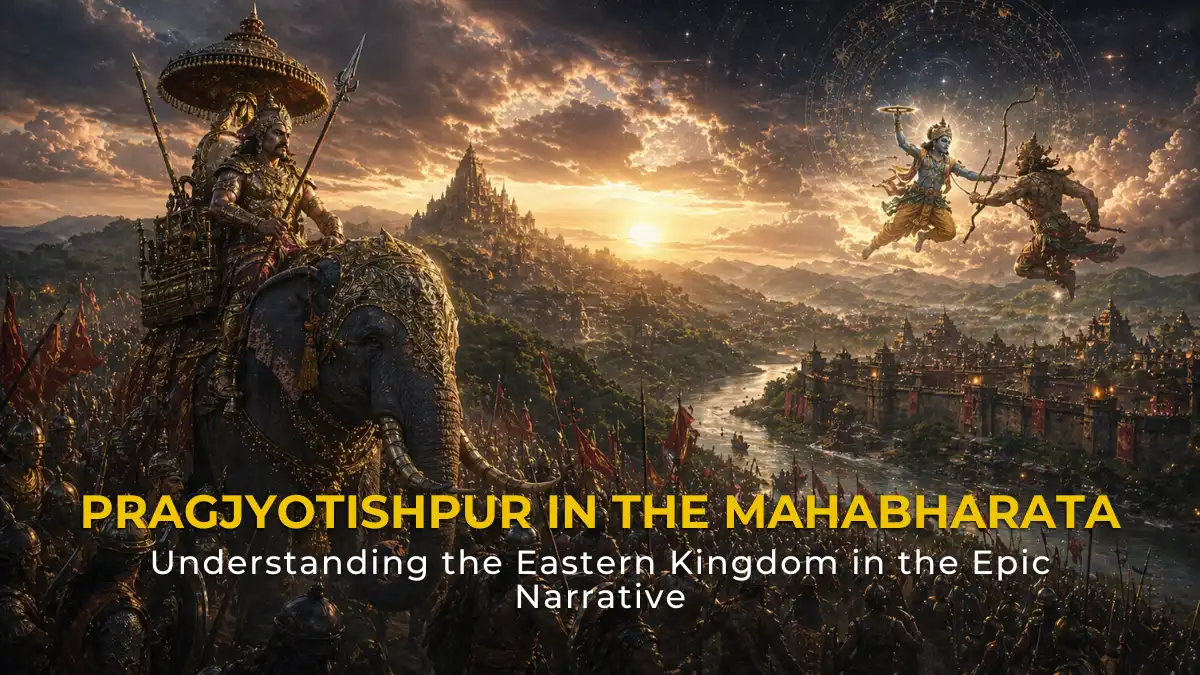

When people explore the history of Guwahati or ancient Assam, the name Pragjyotishpur often appears as a starting point. But before connecting it to later kingdoms, temples, or archaeology, there is one critical question that needs to be answered clearly:
How does the Mahabharata itself describe Pragjyotishpur?
This article does not attempt to reconstruct the full history of the region. Instead, it focuses on a much more specific and important task, understanding how Pragjyotishpur is positioned within the Mahabharata, one of the most influential texts in Indian civilizational memory.
In the epic, Pragjyotishpur is not introduced as a vague or decorative location. It appears as:
- A recognized eastern kingdom
- A land associated with powerful rulers like Naraka and Bhagadatta
- A region that participates directly in the Kurukshetra war
- A territory that contributes to the political and military landscape of Bharatavarsha
This is significant.
Because the Mahabharata does not casually include kingdoms. Every region mentioned contributes to the epic’s attempt to represent a vast and interconnected world of rulers, alliances, and conflicts.
Understanding Pragjyotishpur in this context allows us to see it not just as a mythological reference, but as:
- A frontier power in epic geography
- A militarily relevant kingdom
- And a politically meaningful entity within the narrative of the war
At the same time, the Mahabharata is not a modern historical document. It blends memory, mythology, and political imagination. So the challenge is not simply to accept or reject its descriptions, but to read them carefully, as a text that reflects how ancient India imagined its own world.
In the sections that follow, we will break this down in detail:
- What the Mahabharata means when it refers to Pragjyotishpur
- How the kingdom is placed geographically and politically
- Why Bhagadatta becomes the key link
- And what this tells us about the epic’s view of the eastern frontier
What does the Mahabharata mean when it refers to Pragjyotishpur?
When the Mahabharata refers to Pragjyotishpur (Pragjyotisha), it is not introducing an unknown or ambiguous land. Instead, it is referencing a recognized political entity within its narrative world, a kingdom that already holds identity, leadership, and military presence.
This is important to understand from the beginning.
Because in the structure of the Mahabharata, regions are not described randomly. Each kingdom that appears is placed within a network of power, alliances, and geography. Pragjyotishpur is part of that system.
A Named Kingdom, Not a Passing Reference
In the epic, Pragjyotishpur appears as:
- A named kingdom, not just a region
- A territory ruled by identifiable kings
- A land associated with lineage and succession
This is evident through the figures connected to it:
- Naraka (Narakasura) — associated with the early identity of the kingdom
- Bhagadatta — the most prominent Mahabharata-era ruler of Pragjyotishpur
- Vajradatta — mentioned in later epic traditions as Bhagadatta’s successor
The presence of a lineage is crucial. It tells us that Pragjyotishpur is treated as a structured monarchy, not a mythic wilderness.
Placement Within the Political World of the Epic
The Mahabharata presents a wide political landscape that includes:
- Central kingdoms like Hastinapura
- Western and southern rulers
- Himalayan and frontier territories
Within this, Pragjyotishpur is placed in the far eastern direction.
But this “distance” does not reduce its importance.
Instead, it does two things:
- It expands the geographical scope of the epic
- It adds to the diversity of political powers involved in the narrative
In other words, Pragjyotishpur helps the Mahabharata feel like a story that covers an entire subcontinent, not just a single region.
A Kingdom Recognized Through Its Ruler
One of the defining features of how the Mahabharata presents regions is this:
- Kingdoms are often understood through their kings.
- Pragjyotishpur follows the same pattern.
The text does not spend time describing:
- Cities in architectural detail
- Administrative systems
- Economic structure
Instead, it makes the kingdom visible through:
- The authority of its ruler
- His participation in the war
- His impact on the battlefield
This is why Bhagadatta becomes central to understanding Pragjyotishpur in the Mahabharata. Through him, the kingdom is not just mentioned, it is experienced in action.
Not Fully Descriptive, Yet Not Vague
The Mahabharata does not provide:
- Exact geographical coordinates
- Detailed urban descriptions
- Archaeological-style documentation
But that does not make Pragjyotishpur vague.
Instead, the epic gives us:
- Direction (far east)
- Political identity (a ruled kingdom)
- Military strength (through Bhagadatta)
- Narrative relevance (participation in Kurukshetra)
This is a different kind of clarity, not scientific, but narrative-functional clarity. The kingdom is defined by what it does in the story, not by how it is mapped.
Why This Framing Matters
Understanding how the Mahabharata refers to Pragjyotishpur helps us avoid two common mistakes:
Mistake 1: Treating it as purely fictional
The structured references, named rulers, and war participation suggest otherwise.
Mistake 2: Treating it as a fully documented historical capital
The epic does not function like a modern historical record.
The correct position lies in between: Pragjyotishpur is presented as a real and recognized kingdom within the epic imagination of ancient India.
Pragjyotishpur as an Eastern Kingdom in the Epic World
To understand Pragjyotishpur in the Mahabharata, you have to see how the epic builds its map of power.
The Mahabharata is not just a story about a single war. It is an attempt to represent an entire civilizational landscape, a network of kingdoms spread across different directions, each contributing to the scale of the conflict.
Within this framework, Pragjyotishpur is placed in a very specific role:
It represents the far eastern frontier of the epic world.
The Directional Logic of the Mahabharata
The Mahabharata organizes its geography directionally:
- North → Himalayan regions
- West → Gandhara and beyond
- South → peninsular kingdoms
- East → distant, powerful, and often less familiar territories
Pragjyotishpur belongs to this eastern category.
But this is not just about direction. Direction in the Mahabharata carries meaning.
The east is:
- Distant from the political center (Hastinapura)
- Less directly controlled by central powers
- Yet still connected enough to participate in major events
So when Pragjyotishpur is placed in the east, it is being positioned as:
A frontier kingdom that is outside the immediate core, but not outside the system
Distance Without Isolation
One of the most important aspects of Pragjyotishpur’s placement is this:
It is far, but not disconnected. This is visible in two ways:
1. It Has Its Own Ruler and Identity
Pragjyotishpur is not described as dependent or subordinate. It exists as an independent political entity with its own king.
2. It Participates in the Kurukshetra War
Despite being geographically distant, it sends its ruler, Bhagadatta, to fight.
This tells us something critical:
Distance does not prevent political integration in the Mahabharata’s world. Even frontier kingdoms are part of the larger network of alliances and conflicts.
Why the Mahabharata Needs Frontier Kingdoms
The inclusion of regions like Pragjyotishpur serves a narrative purpose.
It allows the Mahabharata to:
- Expand its scope beyond a local conflict
- Present the war as a pan-Bharata event
- Show that rulers from all directions are involved
Without such kingdoms, the war would feel regional.
With them, it becomes civilizational. Pragjyotishpur plays a key role in this expansion.
The Prestige of Being Included
In the epic world, not every region is named or represented. So when a kingdom appears:
- With a ruler
- With military participation
- With narrative relevance
It gains a certain prestige within the text itself Pragjyotishpur is one such kingdom.
Its inclusion signals that:
- It was considered important enough to be remembered
- It had a reputation that fit within the epic’s scale
- It could contribute meaningfully to the war narrative
The Eastern Frontier as a Zone of Strength
Another subtle aspect of this placement is how the east is imagined. The Mahabharata does not portray the eastern frontier as weak or primitive. Instead, through characters like Bhagadatta, it presents it as:
- Militarily capable
- Resource-rich (especially in terms of elephant warfare)
- Governed by experienced rulers
This challenges a simplistic reading where the center is “civilized” and the frontier is “lesser.”
In the epic’s logic:
The frontier is different, but not inferior.
A Kingdom Defined by Its Reach
By placing Pragjyotishpur in the eastern edge and still bringing it into the Kurukshetra war, the Mahabharata achieves something powerful:
It shows that the influence of the central conflict extends across vast distances. And at the same time, it shows that distant kingdoms are:
- Aware of central politics
- Capable of intervention
- Willing to take sides
This makes Pragjyotishpur both:
- A geographical boundary
- And a political participant
The Naraka Connection – Why Pragjyotishpur Enters Epic Memory
Before Pragjyotishpur becomes visible in the Mahabharata through active participation in war, it already carries a narrative memory one that is tied to the figure of Naraka (Narakasura).
However, this layer needs to be handled carefully. Because unlike Bhagadatta, whose role in the Kurukshetra war is clearly described, Naraka exists at the edge of the Mahabharata tradition—partly present, partly expanded in later literature.
Naraka in the Mahabharata Tradition
In the broader epic tradition associated with the Mahabharata:
- Naraka is identified as an early ruler of Pragjyotishpur
- He is remembered as powerful, sometimes oppressive
- He is associated with a fortified and difficult-to-access kingdom
But in the core war narrative of the Mahabharata, Naraka is not given extended narrative space. His story is not unfolded in detail during the Kurukshetra episodes.
Instead, his presence is:
- Referred to
- Carried forward through lineage
- Expanded more fully in later Puranic texts
This distinction is important.
Why Naraka Still Matters in the Mahabharata Context
Even without a detailed storyline in the main war books, Naraka plays a crucial role in shaping how Pragjyotishpur is perceived.
He provides:
1. A Foundational Identity
By associating the kingdom with a powerful early ruler, the tradition gives Pragjyotishpur depth and antiquity. It is not a newly emerged state, it has a past.
2. A Reputation of Strength and Resistance
Naraka is often linked with:
- Strength
- Defiance
- Control over a fortified region
This contributes to the image of Pragjyotishpur as a difficult and formidable territory.
3. A Lineage That Leads to Bhagadatta
Most importantly, Naraka’s role continues through his son:
Bhagadatta
This connection does two things:
- It links mythic memory to active participation in the war
- It allows the Mahabharata to present Pragjyotishpur as a kingdom with continuity
So even if Naraka is not fully narrated in the war, his presence is inherited by Bhagadatta.
The Transition from Mythic Ruler to War Participant
This is where the structure becomes interesting. Naraka represents:
- The earlier layer of memory
- A semi-mythic or pre-war identity
Bhagadatta represents:
- The active layer of the epic narrative
- A king who directly enters the battlefield
Together, they create a transition:
From remembered power → to demonstrated power
This makes Pragjyotishpur feel:
- Rooted in the past
- Active in the present
- Relevant to the epic’s central conflict
Why the Epic Keeps Naraka in the Background
There is also a narrative reason why Naraka is not fully developed in the Mahabharata’s main storyline. The epic’s focus is on:
- The Kuru conflict
- The Kurukshetra war
- The immediate political tensions between Pandavas and Kauravas
Expanding Naraka’s story in detail would shift focus away from this core narrative. So instead, the text does something efficient:
- It acknowledges Naraka
- Uses him to establish lineage
- Then moves forward with Bhagadatta
This allows Pragjyotishpur to enter the story without diverting attention from the main plot.
A Layered Identity, Not a Single Narrative
Because of this structure, Pragjyotishpur in the Mahabharata carries two overlapping identities:
- A kingdom with an older, powerful ruler (Naraka)
- A kingdom actively participating in the war (Bhagadatta)
This layered identity makes it richer than a one-dimensional mention.
Bhagadatta- The Strongest Mahabharata Link to Pragjyotishpur
If Pragjyotishpur exists in the Mahabharata as a recognizable kingdom, it is because of one figure:
King Bhagadatta.
- He is not a background reference.
- He is not symbolic.
- He is active, visible, and impactful within the Kurukshetra war.
Through him, Pragjyotishpur moves from being a distant name to a present force on the battlefield.
The King Who Represents the Kingdom
In the Mahabharata, regions are rarely described independently.
They are represented through:
- Their rulers
- Their military strength
- Their role in the conflict
Bhagadatta fulfills all three. He is explicitly identified as:
- The ruler of Pragjyotishpur
- The son of Naraka
- A powerful and experienced warrior
This is important because it gives Pragjyotishpur:
- A face
- A voice
- And a place in the war narrative
Without Bhagadatta, Pragjyotishpur would remain a distant reference. With him, it becomes present and relevant.
An Experienced Warrior, Not a Peripheral Fighter
The Mahabharata does not portray Bhagadatta as a minor participant. Instead, he is described as:
- Elderly, yet formidable
- Skilled in warfare
- Capable of causing significant damage in battle
This characterization matters. Because the epic often uses age differently than modern narratives:
- Age here represents experience, authority, and tested strength
Bhagadatta is not just another king in the war. He is a seasoned combatant whose presence shifts the battlefield dynamic.
Entry into the Kurukshetra War
Bhagadatta joins the war on the Kaurava side. This alone carries weight. Because alliances in the Mahabharata are not random:
- They reflect political relationships
- They indicate loyalty networks
- They show how far the influence of the Kuru conflict extends
By bringing Bhagadatta into the Kaurava alliance, the epic demonstrates that:
Even distant eastern kingdoms are drawn into the central political struggle.
A Kingdom Seen Through Action
The Mahabharata does not describe Pragjyotishpur in architectural or administrative detail. Instead, it shows the kingdom through Bhagadatta’s:
- Movements in battle
- Combat ability
- Impact on opposing forces
This is a narrative technique. Rather than telling us what the kingdom is like, the epic shows us:
What kind of power it can project
And that power is:
- Direct
- Physical
- Military
The Battlefield Presence
When Bhagadatta appears in the war:
- He does not stay at the margins
- He engages directly with key warriors
- He disrupts formations
- He creates pressure on the Pandava side
This indicates something important about how Pragjyotishpur is imagined:
- It is not a symbolic ally.
- It is a functional military force.
The Link Between Geography and Warfare
Bhagadatta’s style of warfare reflects his regional identity. He is strongly associated with:
- Elephant warfare
- Heavy battlefield presence
- Direct engagement
This is not accidental. The Mahabharata often aligns:
- Geography → with → military specialization
By linking Bhagadatta to elephant combat, the epic indirectly reinforces the idea that:
Pragjyotishpur is a region of strength, scale, and resource power.
From Lineage to Legacy
Bhagadatta also completes the narrative transition we saw earlier:
- Naraka establishes the memory of power
- Bhagadatta demonstrates the reality of power
This makes Pragjyotishpur feel:
- Historically rooted
- Militarily active
- Politically relevant
It is not just remembered—it is experienced in the present narrative.
Why Bhagadatta Fights on the Kaurava Side
Bhagadatta’s presence in the Kurukshetra war is not just important because he fights, it is important because of which side he chooses.
In the Mahabharata, alliances are rarely arbitrary. When a king joins either the Pandavas or the Kauravas, it reflects a mix of:
- Political relationships
- Historical associations
- Personal loyalties
- Strategic positioning
So when Bhagadatta, the ruler of Pragjyotishpur, fights for the Kauravas, it raises a deeper question:
Why would a distant eastern king align himself with the Kaurava camp?
Not a Random Alignment
The Mahabharata presents Bhagadatta’s allegiance as natural, not surprising. This suggests that his alignment fits within the broader political logic of the epic world. We can understand this through multiple overlapping factors.
1. Alignment Through Political Networks
The Mahabharata’s war is not just a family dispute—it is a networked conflict involving many kingdoms.
Kings align based on:
- Prior relationships
- Diplomatic ties
- Mutual recognition of authority
The Kauravas, especially under Duryodhana, actively build a coalition of powerful rulers.
Bhagadatta’s inclusion indicates that:
- Pragjyotishpur was part of this wider network
- It had existing or compatible ties with the Kaurava side
- It recognized the legitimacy, or at least the authority, of the Kaurava claim
This places Pragjyotishpur inside the political map of alliances, not outside it.
2. Generational Loyalty and Continuity
The Mahabharata often emphasizes continuity between generations of rulers.
Bhagadatta, being an older and experienced king, represents:
- A pre-existing political order
- Older alliances and loyalties
- Stability over disruption
The Pandavas, by contrast, represent:
- A shift in power
- A challenge to the existing structure
- A new political configuration
From this perspective, Bhagadatta’s alignment with the Kauravas can be seen as:
Support for continuity over change
He is not just choosing a side, he is aligning with what may have been perceived as the established order.
3. The Role of Distance and Perspective
Pragjyotishpur is geographically distant from the Kuru heartland. This distance matters. Because it affects how the conflict is perceived. For a distant ruler like Bhagadatta:
- The war may not appear as a moral struggle between right and wrong
- It may appear as a power struggle between two royal factions
In such cases, alignment is influenced less by ethical narratives and more by:
- Political advantage
- Diplomatic positioning
- Strategic alignment
From this viewpoint, joining the Kauravas could have been:
- A calculated decision
- Based on perceived strength, stability, or influence
4. The Kaurava Coalition Strategy
Duryodhana’s strength in the Mahabharata lies in his ability to:
- Build a wide and diverse alliance
- Bring together rulers from different regions
- Strengthen his side numerically and strategically
Bhagadatta’s presence reinforces this strategy. It shows that the Kaurava camp includes:
- Central powers
- Western allies
- Frontier kingdoms like Pragjyotishpur
This diversity strengthens the narrative that:
The Kauravas represent a broad political coalition, not just a single kingdom.
5. Battlefield Role and Strategic Value
Bhagadatta is not just a symbolic ally.
He brings specific military strengths:
- Elephant warfare
- Heavy battlefield disruption
- Experience in large-scale combat
These strengths are especially valuable in a war like Kurukshetra, where:
- Formations are constantly tested
- Strong units can break lines
- Momentum shifts through force
From a strategic standpoint, Bhagadatta’s inclusion on the Kaurava side:
- Enhances their military capability
- Adds diversity to their fighting methods
- Increases their ability to counter Pandava formations
6. Narrative Balance in the Epic
There is also a storytelling dimension.
The Mahabharata constructs both sides of the war carefully.
- The Pandavas are often framed with moral and dharmic support
- The Kauravas are given military strength and powerful allies
Bhagadatta contributes to this balance. His presence ensures that:
- The Kaurava side is not weak or one-dimensional
- The war feels evenly matched
- The conflict remains intense and unpredictable
In this sense, his alignment is not just political, it is also narratively functional.
7. Pragjyotishpur as a Participating Power
Through Bhagadatta’s choice, the Mahabharata communicates something broader: Pragjyotishpur is not:
- Isolated
- Neutral
- Detached from central events
It is:
- A decisive participant in the war
- A kingdom capable of choosing sides
- A power that influences the course of battle
This reinforces its status as a politically active and integrated kingdom within the epic world.
Pragjyotishpur and the Military Image of Power in the Mahabharata
If Bhagadatta is the strongest Mahabharata link to Pragjyotishpur, then warfare is the strongest lens through which the epic makes Pragjyotishpur memorable.
The Mahabharata does not spend much time giving us a formal description of Pragjyotishpur’s administration, economy, or city planning. Instead, it makes the kingdom visible through combat presence. In other words, Pragjyotishpur is not explained to the reader as a place through abstract detail; it is revealed through the battlefield force of its ruler. That is one of the most important things to understand about how the epic constructs its political geography.
This means that in the Mahabharata, Pragjyotishpur enters epic consciousness not as a quiet eastern territory, but as a kingdom of battlefield weight.
The Kingdom Is Remembered Through Force, Not Description
Many places in the Mahabharata are remembered because of one defining narrative function. In the case of Pragjyotishpur, that function is military power.
Bhagadatta is not introduced in a decorative way. He is not there merely to prove that the war had participants from many regions. The text gives him actual battlefield agency. In Drona Parva, he attacks Bhima, devastates parts of the Pandava side, withstands pressure from multiple warriors, and is described as producing fear and chaos through his elephant assault. The epic even emphasizes that a single elephant under his command seemed, amid dust and confusion, almost multiplied across the field because of the terror it generated.
That is not the profile of a token ally. That is the profile of a kingdom whose power is made legible through shock, pressure, and battlefield disruption.
Bhagadatta as a Military Type
The Mahabharata presents Bhagadatta as a very specific kind of warrior.
He is:
- old, but not weakened,
- royal, but not passive,
- and most importantly, a battlefield commander whose power is expressed through massive mounted force, especially elephant warfare.
This combination matters. In epic logic, old age often signals not decline but authority, endurance, and proven martial experience. Bhagadatta’s image is therefore not that of an impulsive young warrior. He appears as an established king whose military presence carries accumulated weight. That gives Pragjyotishpur a corresponding image: not a young rising state, but a kingdom of seasoned force.
Why Elephant Warfare Matters So Much
The military image of Pragjyotishpur in the Mahabharata is inseparable from the elephant. This is not a small detail. In epic warfare, elephants are not merely vehicles. They represent:
- battlefield dominance,
- psychological intimidation,
- crushing momentum,
- and royal prestige.
In the Drona Parva account, Bhagadatta’s elephant becomes the center of an entire sequence of battlefield collapse and resistance. The text describes the animal destroying Bhima’s chariot, scattering formations, hurling cars away, trampling steeds, and spreading panic so intensely that Pandava troops fled in disorder. Bhagadatta himself is shown controlling and directing this force with skill, including with the elephant-hook, which emphasizes technique as much as strength.
So when readers remember Bhagadatta, they do not remember him only as “a king from the east.” They remember him as the ruler whose war elephant could break formations and terrify armies. Through that image, Pragjyotishpur becomes associated with a military identity that is heavy, formidable, and difficult to stop.
Military Image as Regional Identity
The Mahabharata often links kingdoms to their battlefield character. This is one of the ways the epic gives texture to its wider political world.
In Bhagadatta’s case, the association with elephant warfare is so strong that it effectively becomes the military signature of Pragjyotishpur within the text. The kingdom is not mapped in modern detail, but it is characterized through martial specialization. Bhagadatta’s rule, his command style, and the use of Supratika make Pragjyotishpur appear as a land of strength, terrain mastery, and resource-backed war capacity.
This is important because it shows that the Mahabharata does not imagine frontier kingdoms as automatically peripheral or weak. On the contrary, Pragjyotishpur is made memorable by possessing a distinct military profile that even central heroes must reckon with.
The Battlefield Effect of Bhagadatta’s Assault
The epic account goes beyond simple praise. It dramatizes effect. Bhagadatta’s elephant does not merely enter battle; it changes the battle’s rhythm. The text describes:
- Bhima being forced into desperate survival maneuvers beneath the elephant,
- Yudhishthira and others surrounding Bhagadatta,
- the Dasarna king challenging him with another elephant,
- that opposing elephant being ripped open,
- Satyaki’s chariot being seized and hurled away,
- and repeated scenes of troops fleeing in panic.
This level of detail matters because it converts Bhagadatta from “named ally” into “battlefield event.”
And because he is the ruler of Pragjyotishpur, that event becomes a statement about the kingdom itself. The implied message is clear: Pragjyotishpur is not just politically allied with the Kauravas, it is capable of sending into the war a force powerful enough to destabilize elite opposition.
Fear as a Marker of Power
One of the most revealing aspects of this episode is how much emphasis the text places on fear.
The Pandava forces are not shown as casually absorbing Bhagadatta’s attack. They are shaken by it. The noise, confusion, dust, and apparent multiplication of the elephant across the battlefield create a sense that this is more than ordinary combat. It is the arrival of a force that overwhelms perception itself.
In epic literature, this is crucial. Military power is not measured only by body count or technical victory. It is also measured by:
- who causes disruption,
- who breaks morale,
- and who compels the enemy to react.
By that standard, Bhagadatta’s presence is enormous. Which means the Mahabharata gives Pragjyotishpur not just military relevance, but military aura.
Pragjyotishpur as More Than a Distant Ally
Because of this, we should not read Pragjyotishpur in the Mahabharata as merely an eastern kingdom that happened to send one king to war.
The text does much more than that. It uses Bhagadatta’s battlefield performance to signal that Pragjyotishpur possesses:
- strength,
- maturity,
- strategic value,
- and a recognizable military style.
Bhagadatta is also identified in Mahabharata tradition as the ruler of Pragjyotisha, and in Sabha Parva he appears as a king significant enough to be named among major rulers and tribute-bearers. That wider textual presence supports the idea that his war role is not accidental but consistent with the prestige of his kingdom in the epic framework.
So the military image is reinforced at two levels:
- by status in the political landscape,
- and by spectacle in the war narrative.
The Strategic Meaning of This Military Image
There is also a broader interpretive point here. Why does the Mahabharata choose to make Pragjyotishpur memorable in this way?
Because the epic needs frontier kingdoms to feel real, consequential, and worthy of inclusion in a war of subcontinental scale. A named kingdom from the far east becomes far more convincing when it is embodied by a warrior who can visibly challenge the balance of battle. Bhagadatta does exactly that. He gives Pragjyotishpur narrative density.
This is why military imagery is so important here. It is not only about war. It is about epic legitimacy.
A kingdom that can alter the war is a kingdom that belongs inside the epic’s political imagination.
Supratika, Elephant Warfare, and the Battlefield Identity of Pragjyotishpur
If Bhagadatta gives Pragjyotishpur a presence in the Mahabharata, then Supratika, his war elephant, gives it a visual identity.
This is not just a detail of combat. It is one of the most defining images through which the epic remembers the kingdom. Because in the Mahabharata, certain warriors are associated with weapons, vehicles, or styles of warfare that become inseparable from their identity:
- Arjuna → the bow and celestial weapons
- Bhima → brute strength and mace combat
- Karna → precision and divine weaponry
In the same way:
Bhagadatta → the elephant Supratika
And through this association:
Pragjyotishpur → elephant-based battlefield dominance
Supratika as More Than a War Animal
Supratika is not presented as an ordinary elephant.
In the Mahabharata’s battle descriptions, it becomes:
- A mobile fortress
- A shock weapon
- A center of chaos and destruction
Its scale, movement, and power are emphasized repeatedly.
This transforms it into something larger than a mount.
It becomes a force multiplier—an extension of Bhagadatta’s command over the battlefield.
The Mechanics of Elephant Warfare in the Epic
To understand why this matters, we need to understand how elephant warfare functions in the Mahabharata’s combat logic. Elephants in the epic are used for:
1. Breaking Formations
Chariots and infantry depend on structure and spacing.
An elephant charge:
- Disrupts alignment
- Collapses formations
- Creates gaps in defensive lines
2. Psychological Shock
Elephants are described as:
- Loud
- Massive
- Unpredictable
Their presence causes:
- Panic among horses
- Loss of coordination
- Fear-driven retreat
3. Vertical Advantage
From the height of the elephant:
- The rider has a superior vantage point
- Can strike downward
- Can oversee battlefield movement
This gives Bhagadatta both control and visibility.
4. Momentum-Based Combat
Unlike chariot duels, elephant warfare is about:
- Forward pressure
- Crushing force
- Continuous advance
This makes it difficult to counter unless specifically targeted.
Bhagadatta’s Mastery Over Supratika
What makes this even more significant is not just the elephant—but the control Bhagadatta exercises over it.
The Mahabharata emphasizes:
- His ability to guide and direct the elephant
- His skill with the elephant-hook (ankusha)
- His precision in targeting enemies
This shows that the power is not random. It is trained, disciplined, and strategically applied.
Battlefield Sequences and Impact
In the war narrative, Supratika becomes the center of multiple high-intensity sequences.
Bhagadatta:
- Charges into Pandava formations
- Engages Bhima directly
- Disrupts chariots and infantry
- Forces even strong warriors into defensive positions
The descriptions highlight:
- Vehicles being overturned
- Soldiers being scattered
- Entire sections of the battlefield falling into disorder
This is not a duel, it is area domination.
Why the Mahabharata Emphasizes This So Strongly
The epic could have described Bhagadatta as a strong warrior in many ways. But it chooses to emphasize:
His identity as an elephant warrior
This choice is meaningful. Because it allows the Mahabharata to:
- Give Pragjyotishpur a distinct military signature
- Differentiate it from other kingdoms
- Create a memorable and visual battlefield presence
In a story with hundreds of warriors, this kind of clear identity marker is essential.
From Individual Strength to Regional Identity
Through repeated association, something subtle happens.
The image of:
- Bhagadatta controlling Supratika
- Breaking formations
- Creating fear
Begins to extend beyond the individual. It starts to represent the kingdom itself. Pragjyotishpur becomes:
- A land of heavy power
- A region capable of fielding massive war assets
- A kingdom whose strength lies in scale and impact
This is how the Mahabharata constructs regional identity, through battlefield expression.
Limits of Power — The Encounter with Arjuna
Despite his strength, Bhagadatta is eventually defeated by Arjuna. This moment is important.
Because it:
- Reinforces Arjuna’s position as a central hero
- Shows that even the strongest allied kings can fall
- Maintains the narrative balance of the epic
But defeat does not erase Bhagadatta’s impact. If anything, it confirms that:
- He was strong enough to require Arjuna’s direct intervention
- His presence had to be resolved at the highest level
The Memory That Remains
After his fall, what remains is not just the fact that Bhagadatta died. What remains is the image:
- A king on a massive elephant
- Charging through formations
- Reshaping the battlefield
This image becomes the lasting memory of Pragjyotishpur within the Mahabharata.
How the Mahabharata Places Pragjyotishpur Geographically
The Mahabharata does not describe geography the way modern history or maps do. There are no coordinates, no precise borders, and no cartographic detail. Yet, the epic is not geographically vague.
Instead, it uses a different system, one based on:
- Direction
- Relative distance
- Political positioning
- Narrative function
Within this system, Pragjyotishpur is consistently placed in a clear and meaningful location:
The far eastern frontier of the epic world.
Direction as Geography in the Mahabharata
To understand this properly, we need to understand how the Mahabharata communicates geography. The epic organizes its world using directions:
- North → mountain regions, Himalayan zones
- West → Gandhara and beyond
- South → peninsular territories
- East → distant and expansive lands
These directions are not just spatial—they are conceptual categories. When a kingdom is placed in a direction, it is also being assigned:
- A position relative to the political center
- A role within the larger world of the epic
Pragjyotishpur, being in the east, is therefore:
- Outside the immediate influence of the Kuru core
- But still within the recognized world of Bharatavarsha
The Meaning of “Far East”
The Mahabharata repeatedly treats the east as:
- Distant from Hastinapura
- Difficult to access
- Yet powerful and resource-rich
This creates a layered meaning. The “far east” is not portrayed as:
- Unknown
- Uncivilized
- Or irrelevant
Instead, it is portrayed as:
- A region with its own rulers
- A territory capable of independent power
- A space that can influence central events when it chooses to participate
Pragjyotishpur fits exactly into this model.
A Frontier, Not a Margin
There is a crucial distinction here. In modern thinking, distance often implies marginality.
But in the Mahabharata:
Distance does not mean insignificance.
Instead, Pragjyotishpur is treated as a frontier:
- A boundary region of the epic world
- A limit of geographical expansion
- A zone where power exists beyond the central core
Frontiers in epic literature often carry importance because they:
- Extend the reach of the narrative
- Demonstrate the scale of the world
- Add diversity to the political landscape
Pragjyotishpur fulfills all these roles.
Connectivity Despite Distance
Even though it is placed in the far east, Pragjyotishpur is not isolated. Its connection to the main narrative is established through:
- Its ruler (Bhagadatta)
- His participation in the war
- His alignment with the Kaurava side
This indicates that:
- Communication exists across distances
- Alliances are not limited by geography
- Political awareness extends beyond immediate regions
In other words:
The Mahabharata’s world is expansive, but interconnected
Pragjyotishpur is proof of that.
Geography Through Movement
Another key aspect of how the Mahabharata defines space is through movement. Instead of describing places statically, the epic shows geography through:
- Armies traveling
- Kings arriving
- Warriors entering the battlefield
Pragjyotishpur’s location becomes meaningful not because it is described on a map, but because:
Bhagadatta travels from it to the center of the war.
This movement implies:
- Distance
- Effort
- Strategic intent
And it reinforces the idea that the kingdom lies at the edge, but is capable of reaching the core.
Terrain Implied, Not Detailed
The Mahabharata does not explicitly describe the terrain of Pragjyotishpur in technical terms. But certain aspects are implied:
- Its association with elephant warfare suggests terrain that supports large animals
- Its depiction as distant suggests challenging routes
- Its frontier placement suggests natural boundaries
These are indirect clues, not formal descriptions. But they are enough to build an image of a region that is:
- Vast
- Resource-rich
- Strategically significant
The Role of Geography in Narrative Scale
Why does the Mahabharata place Pragjyotishpur so far east? Because it serves a narrative purpose.
By including distant kingdoms:
- The war appears larger
- The stakes feel higher
- The world of the epic becomes more complete
Without such placements, the Mahabharata would feel like a localized conflict. With them, it becomes:
A war that draws in the entire known world
Pragjyotishpur is one of the key elements that helps achieve this scale.
Was Pragjyotishpur Symbolic or treated as a Real Kingdom in the Mahabharata
One of the most important questions when reading the Mahabharata is this:
Are the places it mentions meant to be understood as real political entities, or as symbolic creations of epic storytelling?
Pragjyotishpur sits exactly at this intersection.
Because the way it is presented in the Mahabharata does not allow for a simple answer. It is neither purely fictional nor fully documented in the modern historical sense. To understand it properly, we need to examine how the text treats it across multiple layers.
A Kingdom With Structure, Not a Mythic Void
When Pragjyotishpur appears in the Mahabharata, it is not described as:
- A vague land of fantasy
- A supernatural realm
- Or a symbolic metaphor detached from political reality
Instead, it is presented as:
- A ruled territory
- With identifiable kings
- Participating in alliances
- Contributing forces to war
This already places it closer to a political entity than to pure mythology. The presence of rulers like Bhagadatta is especially important here.
Because:
A named king with battlefield agency implies a structured kingdom behind him
Narrative Reality vs Historical Reality
However, we must also recognize the nature of the Mahabharata itself. It is:
- A layered text
- Composed over long periods
- Blending mythology, memory, and political imagination
This creates two different kinds of “reality”:
1. Narrative Reality
Within the story, Pragjyotishpur is real.
- It exists
- It sends a king
- It participates in war
- It influences outcomes
In the logic of the epic, it is fully functional.
2. Historical Reality
From a modern historical perspective:
- The epic does not provide verifiable evidence
- It does not describe administrative or material details
- It does not confirm exact location in archaeological terms
So its existence cannot be treated as proven in a strict academic sense based on the Mahabharata alone.
Why It Cannot Be Dismissed as Pure Fiction
At the same time, dismissing Pragjyotishpur as “just myth” would also be incorrect. Because the Mahabharata:
- Consistently treats it as part of a wider network of kingdoms
- Places it within a geopolitical structure
- Links it to lineage and succession
- Integrates it into a large-scale war narrative
This level of integration suggests that the idea of Pragjyotishpur is rooted in:
- Cultural memory
- Regional identity
- Possibly real political formations known to the composers
So while we cannot confirm it in modern terms, we also cannot treat it as arbitrary invention.
The Middle Ground: Epic Political Memory
The most balanced way to understand Pragjyotishpur in the Mahabharata is this:
It represents a form of epic political memory
This means:
- The text reflects how ancient India imagined its political world
- It includes kingdoms that were known, remembered, or culturally significant
- It preserves names and identities that may have had real-world counterparts
Pragjyotishpur, in this sense, is:
- Not a precise historical record
- But not a fictional construct either
It is a remembered political space, shaped through storytelling.
Why the Epic Treats It as Real
Within the narrative, the Mahabharata treats Pragjyotishpur as real because:
- It needs a complete and expansive world
- It needs multiple power centers
- It needs alliances that extend across regions
By including Pragjyotishpur as a functioning kingdom:
- The war gains scale
- The political network gains complexity
- The narrative gains credibility within its own framework
The Role of Bhagadatta in This Question
Bhagadatta becomes central again here. Because:
- His active role in the war
- His interactions with major warriors
- His battlefield impact
All reinforce the idea that:
Pragjyotishpur is not symbolic within the narrative it is operational
Through him, the kingdom is:
- Seen
- Felt
- And engaged with
A Kingdom That Exists Through Function
The Mahabharata does not prove Pragjyotishpur through:
- Maps
- Documents
- Archaeology
Instead, it proves it through:
- Function
- Participation
- Consequence
If a kingdom:
- Sends a king
- Fights in the war
- Alters the battlefield
Then within the epic’s logic:
That kingdom is real enough to matter
Strategic Importance – Why the Mahabharata needed Pragjyotishpur
By this point, we understand that Pragjyotishpur:
- Exists as a named eastern kingdom
- Is represented through Bhagadatta
- Participates actively in the Kurukshetra war
- Carries both memory (Naraka) and action (Bhagadatta)
But this leads to a deeper question:
Why does the Mahabharata include a distant eastern kingdom like Pragjyotishpur in its narrative at all?
The answer lies not just in geography or storytelling, but in how the epic constructs scale, legitimacy, and completeness.
Expanding the Epic Beyond a Regional Conflict
At its core, the Mahabharata is about a conflict between:
- The Pandavas
- The Kauravas
Both centered around the Kuru kingdom. If the story remained limited to this region, it would appear as:
- A dynastic dispute
- A localized war
But the Mahabharata aims to be something much larger. It presents itself as a story of:
Bharatavarsha as a whole
To achieve this, the epic must:
- Extend beyond the Kuru region
- Include kingdoms from all directions
- Show that the conflict draws in the entire known world
Pragjyotishpur plays a key role in this expansion.
Creating a Pan-Regional War Narrative
By including Pragjyotishpur, the Mahabharata demonstrates that:
- The war is not confined to a central power struggle
- It has pan-regional consequences
- Even distant kingdoms must respond to it
This transforms the Kurukshetra war into:
- A civilizational event
- A conflict that affects the entire political landscape
Pragjyotishpur’s participation strengthens this narrative.
Establishing the Reach of Political Influence
Another strategic function of including Pragjyotishpur is to show the reach of influence of the central powers.
When a distant eastern king like Bhagadatta:
- Joins the war
- Aligns with the Kauravas
- Travels to participate in the conflict
It implies that:
- The political tension of the Kuru dynasty is widely known
- Its outcomes matter beyond its immediate borders
- Its alliances extend across vast distances
This reinforces the idea that:
The Kuru conflict is not local, it is system-wide
Strengthening the Kaurava Coalition
From a narrative and strategic standpoint, Pragjyotishpur adds weight specifically to the Kaurava side.
The Mahabharata carefully balances both sides of the war:
- The Pandavas often carry moral authority
- The Kauravas are shown with numerical and military strength
Bhagadatta’s inclusion strengthens this balance. He brings:
- A powerful military unit (elephant warfare)
- A respected and experienced ruler
- A distant yet significant ally
This ensures that:
- The Kaurava side does not appear weak
- The war remains competitive
- The outcome is not predictable
Representing Frontier Power
Including Pragjyotishpur also allows the Mahabharata to represent frontier regions as powerful and relevant. Without such inclusion:
- The epic world would feel centered only around core kingdoms
- Frontier regions would appear insignificant
But by giving Pragjyotishpur:
- A ruler
- A role in war
- A strong military identity
The epic shows that:
Power exists beyond the center
This is an important narrative statement.
Enhancing Diversity of Warfare
The Mahabharata is not just a political story, it is also a catalog of warfare styles.
Different kingdoms bring:
- Different weapons
- Different tactics
- Different combat traditions
Pragjyotishpur contributes through:
- Elephant warfare
- Heavy assault strategy
- Battlefield disruption
This adds variety and complexity to the war narrative. Without such diversity, the war would feel repetitive. With it, the battlefield becomes:
- Dynamic
- Unpredictable
- Multi-layered
Creating Memorable Narrative Moments
Another strategic reason for including Pragjyotishpur is narrative impact. Bhagadatta’s presence creates:
- High-intensity battle sequences
- Unique visual imagery (elephant warfare)
- Moments of crisis for major characters
These moments are important because:
- They keep the audience engaged
- They elevate the scale of conflict
- They create lasting memory within the story
So Pragjyotishpur is not just included for representation, it is included for dramatic value.
Legitimizing the Epic as a “Complete World”
The Mahabharata aims to present itself as a comprehensive account of its world. To achieve this, it must include:
- Central kingdoms
- Peripheral regions
- Known political entities from across the landscape
Pragjyotishpur helps complete this picture. Its inclusion signals that:
- The epic is aware of distant regions
- It acknowledges their existence
- It integrates them into the narrative
This enhances the epic’s claim to represent a total world, not a partial one.
Political Importance – How Later Traditions could use use this Mahabharata connection
By the time the Mahabharata establishes Pragjyotishpur as:
- A recognized eastern kingdom
- Ruled by figures like Naraka and Bhagadatta
- Actively participating in the Kurukshetra war
It does something more than storytelling. It creates a reference point, one that later traditions, rulers, and regional identities can draw upon.
From Epic Mention to Political Resource
In pre-modern societies, epics like the Mahabharata were not just stories.
They were:
- Sources of legitimacy
- Carriers of cultural memory
- Frameworks through which political identity could be constructed
When a region is mentioned in such a text, it gains something powerful:
A place within a shared civilizational narrative
Pragjyotishpur benefits directly from this. Its presence in the Mahabharata means that:
- It is not outside the epic world
- It is part of the recognized political geography
- It has a lineage tied to epic figures
This makes it usable as a political and cultural asset.
The Power of Lineage in Political Legitimacy
One of the most effective ways rulers in ancient and medieval India established authority was through lineage claims. They would connect themselves to:
- Epic heroes
- Mythical kings
- Divine or semi-divine ancestors
Pragjyotishpur, through the Mahabharata, is already linked to:
- Naraka (earlier ruler figure)
- Bhagadatta (war participant)
This creates a lineage chain that later rulers could adopt. By claiming connection to such figures, a ruler could say:
- Their authority is not new
- Their rule continues an ancient legacy
- Their kingdom is part of a long-standing political tradition
From Narrative Presence to Regional Prestige
Being mentioned in the Mahabharata also elevates the status of a region. Because the epic is:
- Widely known
- Culturally respected
- Deeply embedded in social memory
A place associated with it gains:
- Recognition beyond its local boundaries
- Cultural legitimacy across regions
- A sense of antiquity and importance
For Pragjyotishpur, this means:
It is not just a local kingdom, it is part of a larger, shared story
The Creation of a Continuous Identity
The Mahabharata provides a starting point, but later traditions build upon it. Once Pragjyotishpur is established in the epic:
- Later texts can expand its story
- Religious traditions can attach significance to its geography
- Political narratives can extend its lineage
This creates continuity. Even if the actual political structures change over time, the name and identity remain anchored in epic memory.
Why This Matters for Power Structures
In a world without modern nation-states, legitimacy often came from:
- Tradition
- Recognition
- Narrative authority
A ruler connected to an epic lineage is not just ruling territory, they are:
- Representing continuity
- Inheriting prestige
- Claiming a place within a larger civilizational order
Pragjyotishpur’s Mahabharata connection makes this possible.
The Strategic Value of Being “Remembered”
There is also a deeper layer here.
In the Mahabharata:
- Not every region is named
- Not every kingdom is remembered
- Not every ruler is given narrative presence
So inclusion itself has value. Pragjyotishpur’s presence means:
- It was considered significant enough to be included
- Its rulers were important enough to be remembered
- Its identity was strong enough to persist in narrative form
This makes it a strategic memory point.
From Epic Geography to Political Geography
Over time, epic geography often influences how real geography is understood. When people hear:
- “Pragjyotishpur” in the Mahabharata
They begin to associate that name with:
- A real region
- A real lineage
- A real historical identity
This process gradually transforms:
Narrative geography → into → perceived historical geography
And that transformation has political implications.
What the Mahabharata does not tell us clearly (Limits of the sources)
Up to this point, we have explored how the Mahabharata presents Pragjyotishpur as:
- A recognized eastern kingdom
- A participant in the Kurukshetra war
- A politically and militarily relevant power
But to understand the text properly, we also need to ask:
What does the Mahabharata not tell us about Pragjyotishpur?
This is important. Because without acknowledging these limits, it becomes easy to:
- Over-interpret the text
- Treat narrative elements as verified history
- Or draw conclusions that the source itself does not support
No Precise Geographical Identification
The Mahabharata places Pragjyotishpur in the eastern direction, but:
- It does not give exact coordinates
- It does not define borders
- It does not map the region in modern geographical terms
We are told where it lies in relation to the epic world, not where it lies on a map.
This means:
Any direct identification with a modern location must be interpretative, not definitive.
No Detailed Description of the City or Capital
Unlike modern historical records, the Mahabharata does not describe:
- The layout of Pragjyotishpur
- Its urban structure
- Its fortifications in architectural detail
- Its administrative organization
The epic is not interested in such descriptions. Instead, it focuses on:
- Kings
- Actions
- Events
So while we know Pragjyotishpur is a kingdom, we do not know what it physically looked like.
Limited Information About Governance and Economy
The Mahabharata does not provide:
- Administrative systems
- Revenue structures
- Trade activity
- Social organization
There is no detailed insight into:
- How the kingdom functioned internally
- How it managed resources
- How its society was structured
This means:
The kingdom is visible externally (through war), but not internally (through governance).
Naraka’s Role Is Not Fully Developed in the Core Text
While Naraka is associated with Pragjyotishpur:
- The Mahabharata does not give a full narrative of his reign
- His story is not central to the Kurukshetra war
- Much of his characterization comes from later texts
This creates a gap.
We know Naraka is important, but the epic itself does not fully explain why or how.
No Clear Historical Timeline
The Mahabharata does not operate with a modern sense of time. It does not provide:
- Dates
- Chronological sequencing in a historical sense
- Clear timelines for events across regions
So while Pragjyotishpur appears in the narrative, we cannot place it within a verifiable historical timeline based on the epic alone.
Blending of Myth, Memory, and Narrative
Perhaps the most important limitation is the nature of the text itself.
The Mahabharata is:
- Not purely historical
- Not purely mythological
- But a blend of multiple layers
This means:
- Some elements may reflect real political memory
- Some may be symbolic or narrative-driven
- Some may have been added or expanded over time
Because of this:
It is not always possible to separate fact from interpretation within the text.
Absence of Independent Verification Within the Text
The Mahabharata does not cross-verify its own references in a historical sense. There are no:
- External records within the text
- Comparative documentation
- Independent confirmation of places
So Pragjyotishpur exists only within the narrative framework of the epic itself. This does not make it false, but it limits how it can be used as evidence.
Why These Limits Matter
Understanding these gaps helps us:
- Avoid treating the Mahabharata as a literal historical document
- Recognize the difference between narrative presence and factual proof
- Maintain analytical clarity while studying ancient texts
It allows us to say:
- What the text clearly shows
- What the text suggests
- And what the text does not confirm
How we should understand Pragjyotishpur in the Mahabharata
After examining how the Mahabharata refers to Pragjyotishpur, through its rulers, its battlefield role, its geographic placement, and its narrative function, we arrive at a critical point:
Pragjyotishpur in the Mahabharata is best understood not as a fixed historical location, but as a fully functional political entity within the epic’s world.
This distinction matters.
Because the Mahabharata does not aim to document the past in the way modern history does. Instead, it constructs a world that reflects:
- Political relationships
- Cultural memory
- Narrative logic
- And the scale of a civilizational imagination
Within this framework, Pragjyotishpur plays a specific and meaningful role.
A Kingdom Defined by Participation
The Mahabharata does not prove the existence of Pragjyotishpur through:
- Maps
- Records
- Physical description
Instead, it establishes the kingdom through:
- Its ruler (Bhagadatta)
- His alignment in the war
- His battlefield impact
This creates a different kind of reality. A kingdom that:
- Sends forces
- Engages in combat
- Influences events
Is, within the logic of the epic, real enough to matter.
A Frontier That Is Fully Integrated
Pragjyotishpur is placed at the eastern edge of the epic world. But this placement does not isolate it. Instead, the Mahabharata shows that:
- Frontier regions are connected to central politics
- Distance does not prevent participation
- Power exists beyond the core
This makes Pragjyotishpur both:
- A boundary of geography
- And a participant in the political system
A Kingdom With Layered Identity
Through Naraka and Bhagadatta, Pragjyotishpur carries:
- A memory layer (Naraka)
- An action layer (Bhagadatta)
This gives it depth. It is not introduced as a newly appearing state.
It is presented as:
- A kingdom with a past
- A kingdom active in the present
- A kingdom that fits into the epic’s larger structure
A Military Identity That Defines It
The Mahabharata does not describe Pragjyotishpur in abstract terms. Instead, it gives it a clear battlefield identity through:
- Elephant warfare
- Large-scale force
- Disruptive combat style
This creates a lasting impression. Among hundreds of warriors and kingdoms, Pragjyotishpur is remembered through:
The image of Bhagadatta and his elephant dominating the battlefield
A Necessary Element of Epic Scale
The inclusion of Pragjyotishpur is not accidental. It serves to:
- Expand the epic beyond a regional conflict
- Represent the breadth of Bharatavarsha
- Show that the war draws in distant powers
Without such kingdoms, the Mahabharata would feel limited. With them, it becomes:
A narrative of an entire world in conflict
Between Myth and History
The most accurate way to understand Pragjyotishpur in the Mahabharata is to accept its dual nature. It is:
- Not fully verifiable in a modern historical sense
- Not purely symbolic or fictional
It exists in a middle space:
A remembered political reality shaped through epic storytelling
This allows us to engage with it seriously, without forcing it into categories it does not belong to.
What Pragjyotishpur Ultimately Represents
In the Mahabharata, Pragjyotishpur represents:
- The eastern reach of the epic world
- The presence of frontier power
- The integration of distant kingdoms into central conflict
- The ability of narrative to preserve political identity
It is not defined by its physical description. It is defined by its role, action, and impact.
Conclusion
The Mahabharata does not give us a map of Pragjyotishpur.
It gives us something more powerful:
- A king who fights
- A battlefield where he matters
- A place that influences the course of events
From these elements, a complete picture emerges, not of architecture or borders, but of presence. And that presence is enough to establish Pragjyotishpur as:
A real force within the epic imagination of ancient India
Frequently Asked Questions
1. What is Pragjyotishpur in the Mahabharata?
Pragjyotishpur in the Mahabharata is described as a powerful eastern kingdom ruled by kings like Naraka and Bhagadatta. It is not just a mythological place but a politically active region that participates in the Kurukshetra war, making it an important part of the epic’s geopolitical landscape.
2. Where is Pragjyotishpur located according to the Mahabharata?
The Mahabharata places Pragjyotishpur in the far eastern direction of Bharatavarsha. While it does not give exact geographical coordinates, it clearly presents it as a distant yet connected frontier kingdom that was part of the larger political world of the epic.
3. Who was Bhagadatta in the Mahabharata?
Bhagadatta was the king of Pragjyotishpur and one of the strongest warriors on the Kaurava side during the Kurukshetra war. He is especially known for his mastery in elephant warfare and for creating major disruption in the Pandava army before being defeated by Arjuna.
4. Why did Bhagadatta fight for the Kauravas?
Bhagadatta likely fought for the Kauravas due to political alliances, generational loyalty, and strategic alignment. As an older and established ruler, he may have supported the existing power structure represented by the Kauravas rather than the rising challenge posed by the Pandavas.
5. What role did Pragjyotishpur play in the Kurukshetra war?
Pragjyotishpur played an active military role in the Kurukshetra war through its king Bhagadatta. He contributed significantly to the Kaurava forces by using elephant warfare to break formations and create fear, making the kingdom a visible and impactful participant in the epic.
6. Is Pragjyotishpur a real place or a myth?
Pragjyotishpur is presented in the Mahabharata as a real kingdom within the narrative, but it cannot be fully verified as a historical location based on the epic alone. It is best understood as a blend of political memory and epic storytelling rather than pure myth or confirmed history.
7. Why is elephant warfare associated with Pragjyotishpur?
Elephant warfare is associated with Pragjyotishpur because its king Bhagadatta is depicted as a master of this combat style in the Mahabharata. His elephant, Supratika, becomes a symbol of the kingdom’s military strength and plays a major role in shaping its battlefield identity.
8. How important is Pragjyotishpur in the Mahabharata?
Pragjyotishpur is important because it represents the eastern frontier of the epic world and participates directly in the Kurukshetra war. Its inclusion expands the scale of the Mahabharata, showing that the conflict involved kingdoms from across the entire subcontinent.
9. Does the Mahabharata describe Pragjyotishpur in detail?
No, the Mahabharata does not provide detailed descriptions of Pragjyotishpur’s city, administration, or economy. Instead, it defines the kingdom through its ruler, Bhagadatta, and his actions in the war, focusing more on narrative role than physical description.
10. Why is Pragjyotishpur important for understanding Guwahati’s history?
Pragjyotishpur is important because it is considered the earliest known name associated with the region around present-day Guwahati. Its mention in the Mahabharata connects the region to ancient epic traditions and gives it a place within the broader cultural and political memory of India.