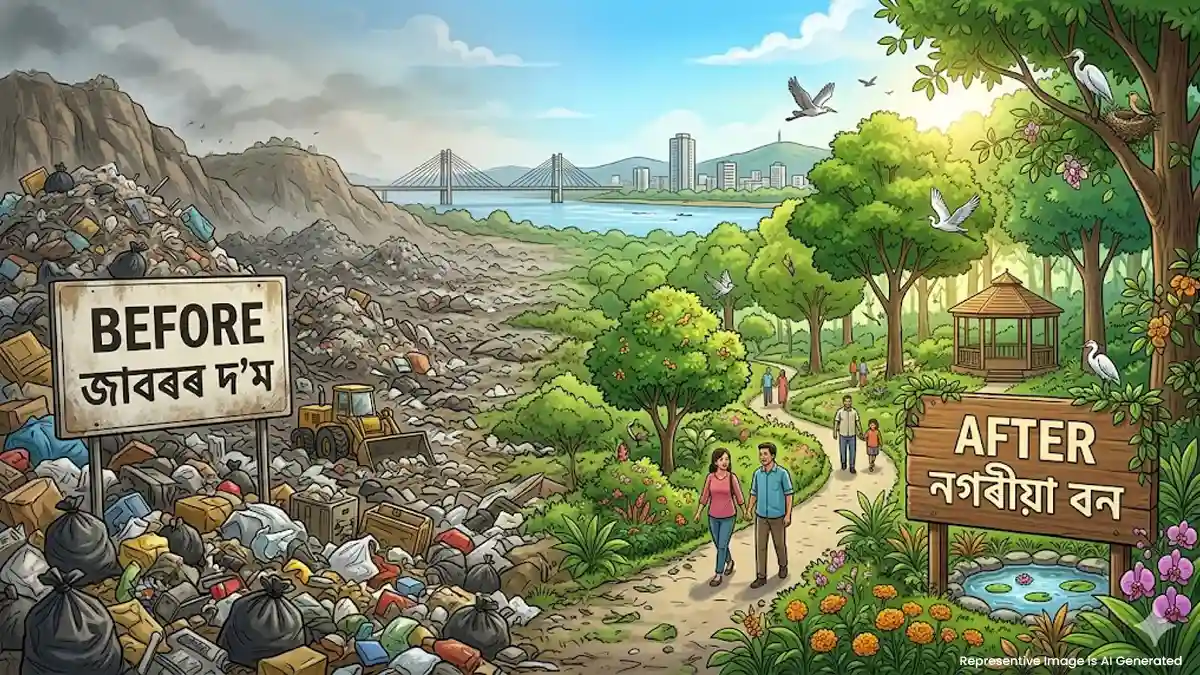
Guwahati May Turn Garbage Dump into Urban Forest
Guwahati may soon see a major environmental transformation as the Assam government plans to convert a garbage dump into an urban forest after clearing accumulated waste from the site.
The proposal was revealed by Assam Housing and Urban Affairs Minister Jayanta Mallabaruah during an episode of the Guwahati Connection podcast, where he spoke about future plans for improving the city’s waste management and urban environment.
Assam Housing and Urban Affairs Minister Jayanta Mallabaruah said Guwahati may develop an urban forest by transforming a garbage dump after removing the accumulated waste. The proposal is part of broader efforts to improve waste management in the city, which currently generates around 500–600 metric tonnes of garbage every day.
Plan to Convert Dump Site into Green Space
Speaking during the podcast, Mallabaruah said the government is exploring a plan to convert an existing garbage dump into an urban forest once the waste stockpile is removed.
“We have a plan to transform a garbage dump into an urban forest by removing the waste,” the minister said during the discussion.
Urban forests are often developed within city limits to improve environmental conditions, increase green cover, and provide natural spaces for residents.
Rising Garbage Generation in Guwahati
During the conversation, the minister also highlighted the growing challenge of waste management in Guwahati.
According to him, the city currently collects around 500–600 metric tonnes of garbage every day.
However, due to limitations in processing capacity, only about 300–400 metric tonnes of waste are processed daily.
Improving garbage processing efficiency remains one of the key priorities for the state government and municipal authorities.
MoU Signed for Waste-to-Power Initiative
Mallabaruah also revealed that the Assam government has recently signed a Memorandum of Understanding (MoU) with Oil India Limited to explore the use of garbage for power generation.
The initiative is part of broader discussions on how waste can be converted into useful resources rather than simply being dumped.
Waste-to-energy projects have been introduced in several cities across India as part of urban waste management strategies.
Recycling Plant Under Consideration
The minister also mentioned that the government is considering establishing a garbage recycling plant in Guwahati.
However, he noted that the city may not currently generate the extremely large volumes of waste required for such a facility to operate at maximum efficiency.
Even so, authorities are continuing to evaluate options for improving waste treatment and recycling infrastructure in the city.
Why the Proposal Matters for Guwahati
Urban environmental projects, such as converting waste dump sites into forests, can have multiple benefits for cities.
If implemented, the proposed urban forest could:
- Increase green cover within Guwahati
- Improve local environmental conditions
- Reduce the impact of landfill sites
- Provide new recreational and ecological spaces for residents
Such projects have been implemented in several Indian cities where former landfill sites were transformed into green urban spaces.
What Happens Next
The proposed urban forest project is currently at the planning stage. Authorities will first need to address the removal and treatment of accumulated waste at the identified dump site before redevelopment can begin.
Further details regarding the location, timeline, and implementation of the project are expected to be announced once the plan moves forward.
Frequently Asked Questions
How much garbage does Guwahati generate daily?
Guwahati currently generates around 500–600 metric tonnes of garbage per day, according to Assam Housing and Urban Affairs Minister Jayanta Mallabaruah.
What is the proposed urban forest project in Guwahati?
The Assam government is considering converting a garbage dump into an urban forest after removing the accumulated waste as part of efforts to improve environmental conditions and waste management in the city.