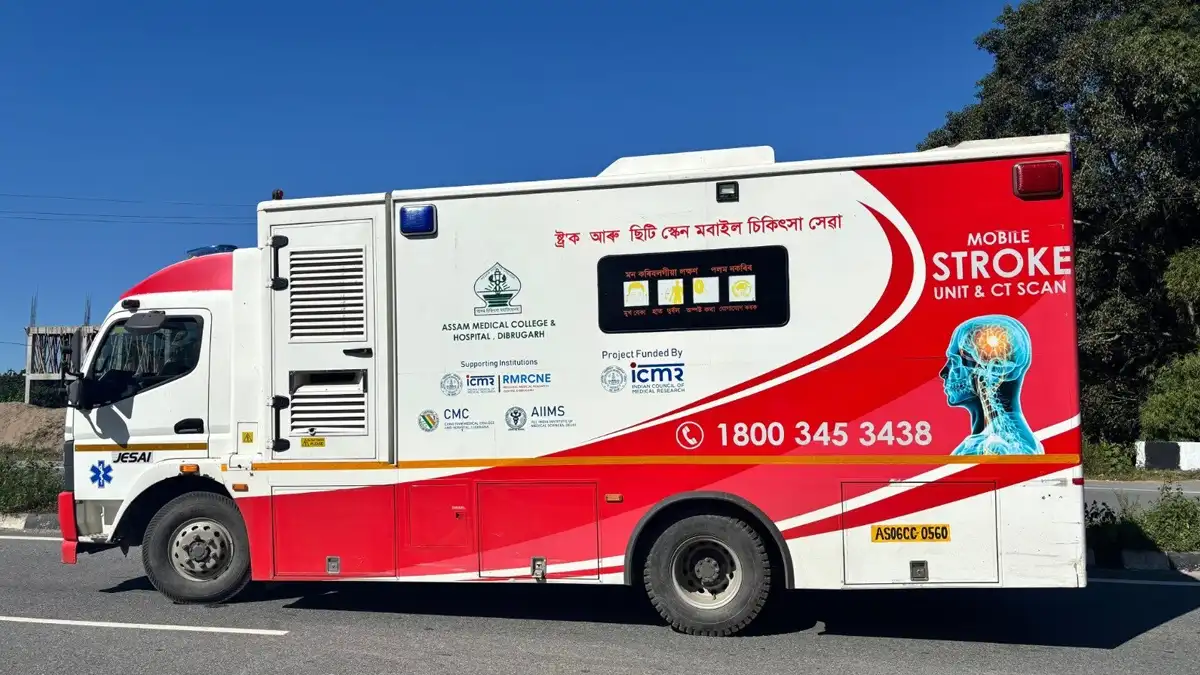
The Indian Council of Medical Research (ICMR) on January 22 officially handed over two specialised Mobile Stroke Units (MSUs) to the Assam Government, strengthening rapid stroke care across the state and improving referral and response capacity linked to Guwahati-based emergency and health networks. The handover ceremony was held at Assam Medical College and Hospital.
With Guwahati serving as Assam’s largest healthcare coordination hub, housing major tertiary hospitals, emergency call centres, and specialist networks, the move is expected to indirectly benefit patients from the city and surrounding districts through faster diagnosis, referrals, and continuity of care.
ICMR has handed over two specialised Mobile Stroke Units to the Assam Government to ensure uninterrupted, rapid stroke care. Stationed at Assam Medical College, Dibrugarh, and Tezpur Medical College, the units enable CT scans, teleconsultation, and clot-busting treatment near patients’ homes, benefiting patients across Assam, including referrals linked to Guwahati.
What Are Mobile Stroke Units?
A Mobile Stroke Unit is a fully equipped hospital-on-wheels designed for emergency stroke care. Each unit includes:
- An onboard CT scanner
- Teleconsultation with stroke specialists
- Point-of-care laboratory facilities
- Clot-busting drugs for immediate treatment
This setup allows doctors to diagnose stroke type early and begin treatment at or near the patient’s home often within the critical “golden hour.”
Where the Units Are Based
The two MSUs have been stationed at:
- Assam Medical College and Hospital (in operation since 2019)
- Tezpur Medical College and Hospital
Although based in Upper and Central Assam, the stroke care network is closely integrated with referral pathways and specialist consultations that extend to major medical centres in Guwahati, where advanced neurological care is concentrated.
Why This Matters for Guwahati
Guwahati functions as the state’s primary medical referral and emergency coordination centre. Faster pre-hospital stroke diagnosis in districts reduces pressure on Guwahati hospitals while ensuring that patients who do need advanced intervention reach the city earlier and in a more stable condition.
Health officials said the MSU model complements Guwahati’s role by:
- Reducing late-stage emergency referrals
- Improving survival and recovery outcomes
- Strengthening links between district-level response and city-based specialists
Impact of the Pilot Project
The MSUs were launched under an ICMR-funded pilot to study stroke care pathways in Upper and Central Assam. According to the Union Health Ministry:
- Treatment time dropped from nearly 24 hours to about 2 hours
- Stroke-related deaths reduced by one-third
- Disability was reduced by eight times
- Over 2,300 emergency calls were received between 2021 and August 2024
- About 90% of patients were treated directly from their homes
Integration with the 108 emergency ambulance service expanded coverage to a 100 km radius.
Official Statement
The Health Ministry noted that the Northeast has a disproportionately high burden of stroke due to difficult terrain and limited access to specialists. To address this, neurologist-led and physician-led stroke units were established and embedded into a pre-hospital care model using MSUs.
With the pilot phase complete, ICMR has now formally donated the units to the Assam Government to continue services without interruption.
What Happens Next
- The Assam Government will operate the MSUs under state management
- Emergency response and referral coordination with Guwahati hospitals will continue
- Expansion of similar stroke care models may be considered in other regions
The initiative marks a significant step in decentralising emergency care while strengthening Guwahati’s role as the backbone of Assam’s healthcare system.
Frequently Asked Questions
What is the purpose of Mobile Stroke Units?
Mobile Stroke Units enable early diagnosis and treatment of stroke at or near a patient’s home, significantly reducing treatment delays and long-term disability.
How does this benefit Guwahati patients?
By enabling faster treatment in districts, patients who need advanced care reach Guwahati earlier and in better condition, easing emergency burden and improving outcomes.