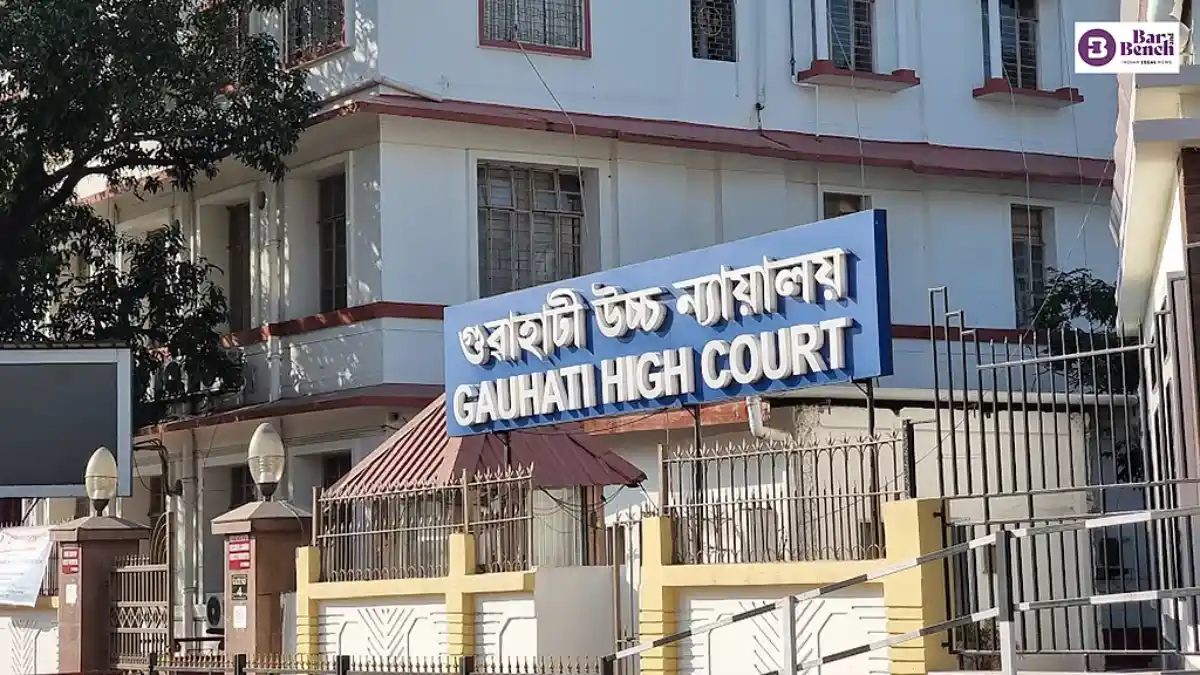
The proposed relocation of the Gauhati High Court has sparked visible unrest in Guwahati, as a foundation stone ceremony in North Guwahati coincided with protests by lawyers across the Brahmaputra in Uzan Bazar on Sunday, January 11.
While the Assam government formally launched construction of a new judicial complex at Rangmahal in North Guwahati, members of the Gauhati High Court Bar Association staged a hunger strike and boycotted the ceremony, reiterating their opposition to shifting the High Court from its historic city-centre location.
The Assam government laid the foundation stone for a new Gauhati High Court complex at Rangmahal in North Guwahati on January 11. At the same time, lawyers in Uzan Bazar protested the relocation, citing a lack of consultation, access concerns, and the heritage value of the existing High Court building.
Foundation Stone Laid in North Guwahati
The foundation stone for the proposed new High Court complex was laid at Rangmahal, North Guwahati, in the presence of Justice Surya Kant. The project is part of a larger judicial township planned by the Assam government.
According to official details:
- The project spans nearly 148 bighas of land
- ₹479 crore has been approved for the first phase
- The full project cost is estimated at ₹1,705 crore
- The complex will include 31 courtrooms, judges’ chambers, and integrated judicial facilities
The government has described the project as essential to meet growing judicial demand.
Government’s Rationale for Relocation
The Assam government has cited a steady rise in the number of court cases and lawyers over the years as the primary reason for relocation. Officials argue that the existing High Court building at Uzan Bazar faces:
- Shortage of courtrooms
- Severe congestion
- Traffic bottlenecks in central Guwahati
According to the government, these factors affect the smooth functioning of the judiciary, making a larger, purpose-built complex necessary.
Lawyers Protest in Uzan Bazar
Even as the ceremony proceeded in North Guwahati, lawyers gathered at Uzan Bazar, the current seat of the High Court, and observed a four-hour strike from 10 am to 2 pm.
Senior advocate AK Talukdar said the relocation would impose daily logistical burdens on legal professionals and litigants. He stated that commuting to Rangmahal could take lawyers over two hours daily and argued that neither the court nor the public had demanded the shift.
Placards at the protest highlighted heritage concerns, with one message stating that the historic 140-year-old High Court building should not be demolished.
Allegations of Inadequate Consultation
Advocates, including Anita Saiki, alleged that the relocation decision lacked transparent consultation with stakeholders. Some lawyers also raised concerns about possible commercial motives behind the project, questioning both intent and process.
The Bar Association has consistently maintained that expansion or renovation of the existing complex should have been explored more seriously.
A City Divided Across the River
The contrasting scenes on January 11, a ceremony in North Guwahati and a protest in Uzan Bazar, symbolised a growing divide in the city. On one side lies the government’s vision of modern judicial infrastructure; on the other, the legal fraternity’s concerns over access, heritage, and public convenience.
For Guwahati, where the High Court has long been part of the city’s civic and historical identity, the debate goes beyond infrastructure.
What Happens Next
Construction work is expected to proceed as per government plans, while the Gauhati High Court Bar Association has indicated that its opposition will continue. Whether dialogue between the state and the legal fraternity can bridge this divide remains uncertain.
Frequently Asked Questions
Q1. Where is the new Gauhati High Court complex being built?
The new complex is proposed at Rangmahal in North Guwahati, across the Brahmaputra River.
Q2. Why are lawyers opposing the relocation?
Lawyers cite a lack of consultation, increased commute time, access issues for litigants, and the heritage value of the existing Uzan Bazar High Court building.